
Ductwork Services
Duct testing, sealing, repair, insulation, and replacement, the unglamorous work that decides whether your HVAC output reaches bedrooms or attics. The EPA pegs typical duct losses at 25 to 30 percent, and we measure yours before and after so the improvement is provable.
Sound Familiar? Problems We Fix Every Week
One room never gets comfortable no matter the season
A disconnected joint, crushed flex run, or severe leak upstream is starving that register. The room is innocent; its supply line is not.
Dust coats everything faster than you can clean it
Leaky return ducts inhale attic insulation fibers and crawlspace dirt, then distribute them house-wide. Sealing the returns cuts the dust off at its source.
Whistling, rattling, or booming from the vents
Whistles mean air forced through gaps, rattles mean loose metal, and booming means duct walls flexing under pressure swings. All three are the system telling on itself.
You replaced the HVAC and the comfort problems stayed
New equipment pushing air into the same broken duct system delivers the same cold bedrooms. The distribution was the problem all along, and it is fixable.
Bills run high for a house your size
When a third of the conditioned air escapes into unconditioned space, the system runs half again longer to compensate, and the meter keeps the receipts.
Musty smells drift from the registers
Return leaks in damp crawlspaces pull moldy air into the supply stream. Sealing the leak beats deodorizing the symptom every time.
What Is Professional Ductwork Services in Northern Virginia?
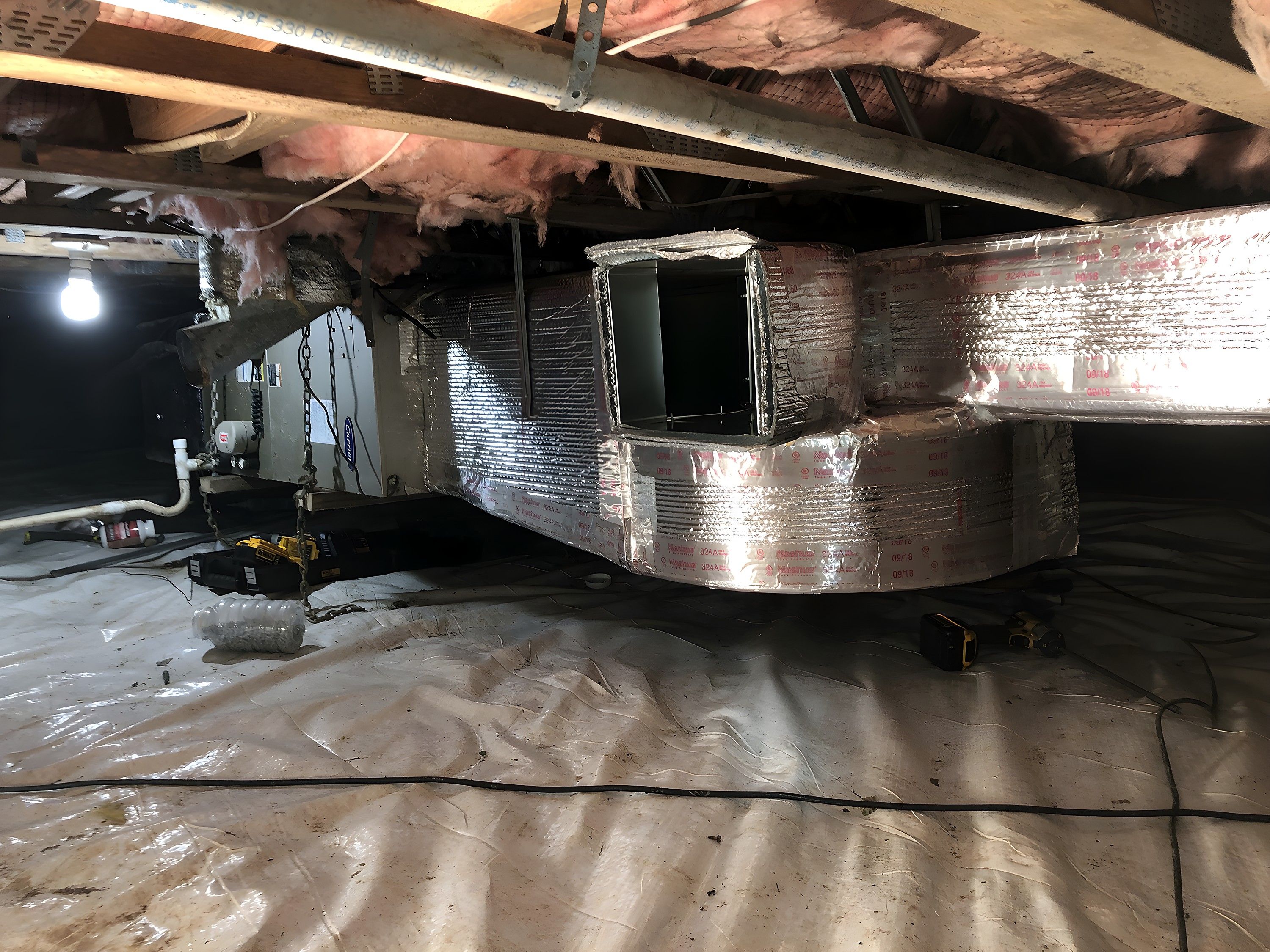
Ductwork is the delivery half of your HVAC system, and it fails silently. Nobody watches a supply joint separate in the attic or a return crack open in the crawlspace; they just notice the far bedroom going cold and the bills going up. The EPA estimates typical homes lose 25 to 30 percent of conditioned air through duct leaks, which means many households effectively pay for four months of heating and cooling a year that never reaches a living space. Our job is finding that loss with instruments and closing it with materials that stay closed.
Construction era predicts the failure mode here. Homes from the 1970s and 1980s in Manassas and Dale City carry original metal duct with mastic long since powdered and joints drifting apart. The 2000s-boom houses in Bristow, Gainesville, and Haymarket got flex duct hung fast against construction deadlines, often sealed with cloth tape that Virginia attics, which top 140 degrees in summer, bake to failure inside two decades. Crawlspace runs west of the suburbs add moisture and the occasional rodent to the abuse list. Different eras, same result: air paid for and never delivered.
The method is measurement bracketed around craftsmanship: pressure-test the system, seal and repair with mastic and metal-backed tape, insulate exposed runs to code with vapor barriers intact, then re-test and hand you the before-and-after numbers. About 80 percent of the systems we evaluate need sealing and selective repairs rather than replacement, and honest testing is what tells the difference. If a room in your house has been unexplainable for years, book a duct evaluation; the answer is probably above your ceiling.
Jim, Owner & Licensed HVAC Contractor since 2021
What Are Ductwork Services?
Ductwork services cover the testing, sealing, repair, insulation, and replacement of the duct system that distributes heated and cooled air through a home. Professional duct work uses pressure testing to measure leakage, mastic and foil tape for permanent sealing, and post-repair verification, recovering the 25 to 30 percent of conditioned air typical systems lose.
What's Included in Ductwork Services?
Duct Sealing
Mastic and foil-tape sealing of joints, boots, plenums, and takeoffs, the permanent materials, not the cloth tape that gave duct tape its ironic name.
Duct Repair
Reconnection of separated joints, replacement of crushed or torn flex, and patching of damaged sheet metal with proper supports to prevent recurrence.
Duct Replacement
Full replacement of systems too deteriorated or badly designed to save, sized correctly for the equipment they serve.
Duct Insulation
Insulation and vapor barriers on runs through attics, crawlspaces, and garages, where bare ducts bleed energy in both seasons.
New Duct Design
Duct systems for additions and renovations engineered for airflow, not squeezed in wherever framing allowed.
How Duct Systems Fail by Construction Era
1970s-80s metal duct: dried seals and drifted joints
Original mastic powders out and slip joints creep open over decades of thermal cycling. The metal is usually fine; the connections are the leak.
2000s flex duct: baked tape and sagging runs
Cloth-taped connections from the building boom fail after 15 to 20 attic summers, while unsupported flex sags into airflow-killing kinks.
Crawlspace runs: moisture and wildlife
Ducts resting on damp ground shed insulation, rust at the seams, and occasionally host tenants. Repairs include supports that get them up off the dirt.
Renovation add-ons: undersized and improvised
Additions ducted by whoever was on site that week often feed a room through a line a third too small. Correct sizing rescues the space.
Single-return floor plans: starved circulation
Many local homes pull all return air through one central grille, leaving far bedrooms pressurized and under-conditioned. Added returns rebalance the whole system.
Any era: the uninsulated attic run
Bare duct in a 140-degree attic reheats your cooling on the way to the register. Insulation recovers capacity you already paid the compressor to make.
Seal and Repair vs. Full Replacement
| Feature | Seal & Repair | Replace |
|---|---|---|
| Share of homes needing it | About 80 percent of systems we test | The remaining rusted-through or misdesigned 20 percent |
| Typical cost | $500 to $2,500 by scope | Priced per project after design |
| Disruption | A day or two in attic and crawlspace | Multi-day with access cuts possible |
| Right answer when | Structure is sound and leaks are the issue | Ducts are collapsed, rusted out, or sized wrong from birth |
| Result | Documented leakage reduction on existing layout | A clean-sheet system engineered for the equipment |
| Verification | Before-and-after pressure testing | Commissioning airflow at every register |
How Does Ductwork Services Work?
Leakage Testing
Calibrated pressure equipment measures how much air your duct system loses per minute, turning a vague comfort complaint into a hard number.
Physical Inspection
We walk the attic, crawlspace, and basement runs looking for separations, crushed flex, failed tape joints, rodent damage, and missing insulation.
Scoped Proposal
Findings arrive with photos and a line-item plan: what to seal, what to replace, what to insulate, and what each piece changes.
Sealing and Repair
Joints get mastic and metal-backed tape, damaged sections get replaced and supported properly, and exposed runs get code-level insulation with vapor barriers intact.
Verification
A post-repair pressure test and register-by-register airflow check document the improvement against the baseline. You see the before and after in numbers.
Why Duct Repair Is a Measurement Job
Leakage in CFM, Not Adjectives
Calibrated pressure testing puts a number on your loss before we propose anything, and 1970s and 1980s systems around here routinely test at 25 to 35 percent.
Mastic Where Tape Failed
The cloth tape on your joints died years ago; building code bans it on ducts for exactly that reason. Mastic and metal-backed foil are what permanence looks like.
Insulation With the Vapor Math Done
Wrong insulation on cold ducts condenses moisture and breeds mold. We install correct thickness with sealed vapor barriers per Virginia code.
Proof at the End
The exit pressure test quantifies the improvement against your baseline. If the number did not move, we have not finished.
Where Do We Offer Ductwork Services?
How Much Does Ductwork Services Cost?
Targeted duct sealing starts around $500 for accessible problem joints and runs to $2,000 for larger homes, while comprehensive sealing of a typical 1,500 to 2,500 square foot system lands between $1,200 and $2,500. Replacing a damaged run costs $400 to $800; insulating exposed ducts costs $8 to $15 per linear foot. The payback is unusually concrete: homes leaking 25 to 30 percent typically see heating and cooling costs drop 15 to 25 percent after sealing, recovering the investment in three to four years while the equipment lives longer for working less. Every job is priced from an actual leakage measurement, so ask for the duct test first.
What Are Common Questions About Ductwork Services?
What does ductwork repair cost in Northern Virginia?
Comprehensive sealing for a 1,500 to 2,500 square foot home runs $1,200 to $2,500, targeted sealing starts near $500, damaged-section replacement runs $400 to $800 per run, and insulation adds $8 to $15 per linear foot. Pricing follows an actual leakage test, not a guess from the driveway.
How do you find leaks without opening my walls?
A duct leakage tester pressurizes the system and measures escape in CFM, which quantifies the problem, and inspection of the accessible runs in attics, crawlspaces, and basements locates it. Between the two, wall demolition is almost never part of diagnosis.
Do I really need replacement, or just sealing?
Statistically, sealing: roughly 80 percent of the systems we test need mastic, selective repairs, and insulation rather than new ductwork. Replacement earns its cost when ducts have rusted through, collapsed, or were fundamentally undersized on day one. The pressure test settles the question objectively.
Why is one bedroom always freezing while the hallway is fine?
Because the duct serving it is leaking, kinked, or disconnected somewhere upstream, or the room cannot return air through a single central grille layout. Register-by-register airflow measurement traces which, and the fix is usually a repair rather than new equipment.
Is sealing worth it if the house feels okay?
Yes, because the waste hides in runtime rather than comfort: a system replacing leaked air runs 40 to 50 percent longer than it should, aging itself and inflating bills while the thermostat looks satisfied. Sealing converts that hidden runtime directly into savings.
What is wrong with regular duct tape?
Its adhesive cooks off in two to three years of attic temperature swings, which is why building code prohibits cloth tape on duct systems. Mastic paste and metal-backed foil tape are the compliant materials, and they hold for decades.
Will sealing actually shrink my bills?
Homes starting at 25 to 30 percent leakage typically cut heating and cooling costs 15 to 25 percent after comprehensive sealing, roughly $30 to $50 a month on a $200 energy budget. Three to four years pays back the project, and the equipment wear you avoid is a bonus on top.
Want to Learn More About Ductwork Services?
What Other HVAC Services Do We Offer?
HVAC Maintenance
Preventive maintenance that actually measures things: amp draws, refrigerant pressures, combustion readings, temperature splits.
AC Installation
New air conditioning sized by Manual J calculation and installed by a Bryant Factory Authorized Dealer.
Indoor Air Quality
Whole-home air quality equipment installed into the HVAC system you already own: media filtration, UV germicidal lights, humidifiers, dehumidifiers, and purifiers.
Ready to Get Started on Your Project?
Get a free instant estimate for ductwork services in Northern Virginia. Air Force One has been serving the region since 2021. Licensed, insured, and ready to work.